

Mastering the PSLE Oral Exam 2025: Reading Aloud & Stimulus-Based Conversation Made Easy!
The PSLE Oral Examination might only last about 10 minutes, but it makes up 20% of your English grade — and it’s your opportunity to show that you can express yourself with confidence, clarity, and purpose.
This guide will walk you through:
- How to ace Reading Aloud
- How to tackle Stimulus-Based Conversation (SBC) using the PEER method
- What the examiners are really looking for
- How to stay calm, sincere, and score in the top band
Reading Aloud: What You Need to Know
Assessment Objective (AO1)
You’ll be assessed on your ability to:
- Read fluently and expressively
- Use clear and accurate pronunciation
- Adjust your tone to match the Purpose, Audience, and Context (PAC)
Why the Preamble Matters
Before the passage, you’ll see a short instruction — this is called the preamble and it’s your clue to reading with the right tone.
Example Preamble:
“You have written the Show-and-Tell script below. You will now present your topic to the class.”
From this, you know:
- Purpose: To present something interesting
- Audience: Your classmates
- Context: A classroom setting
So, read with a friendly and enthusiastic voice — just like you’re sharing something cool during Show-and-Tell to your classmates.
Tips to Ace Reading Aloud
1. Understand the Tone from the Preamble
Match your voice to the situation. Sound excited if it’s a fun story; calm and respectful if it’s serious.
2. Stress Important Words
“My grandfather’s prized possessions are two postcards that are possibly a century old!”
Stress words like prized, postcards, and century to show importance.
3. Pause at Punctuation
Don’t rush!
- Pause at commas → slight pause + a rising intonation to indicate unfinished sentence.
- Pause at full stops → longer pause + a falling intonation to indicate the end of the sentence.
- Also, use a rising intonation for questions.
- Match tone to mood: If it’s cheerful, sound upbeat. If it’s serious, sound respectful.
Stimulus-Based Conversation (SBC)
Assessment Objectives (AO2 & AO3)
Examiners want to see that you can:
- Express your thoughts and opinions clearly and appropriately
- Speak fluently, with clear pronunciation
- Use a wide range of vocabulary and employ accurate grammar
- Engage in a natural conversation by giving personal examples and reflections
How Many Questions Will The Examiner Ask?
Three main questions:
- The first question pertains to the photo. It is the easiest question to predict.
- The second question touches on your personal experience
- The third question seeks your opinion or reflection on the topic/ theme
Using PEER to Structure Your SBC Answer
| PEER | What It Means |
|---|---|
| P – Point | Give a direct answer that addresses the question. |
| E – Explain & Describe | Describe what you see, explain what it might mean, and make inferences. Use clear details and adjectives. |
| E – Experience | Add a short, relevant personal experience that connects to the photo or situation. Take note of the transition like “this reminds me of“, “once” or “[Name] once shared with me that…”, “(in bold in the examples below) to indicate that you are transiting to a sharing of your personal experience. |
| R – Reflect / Recommend | Reflect on the value or importance of the situation. Offer a general comment, insight, or recommendation. |
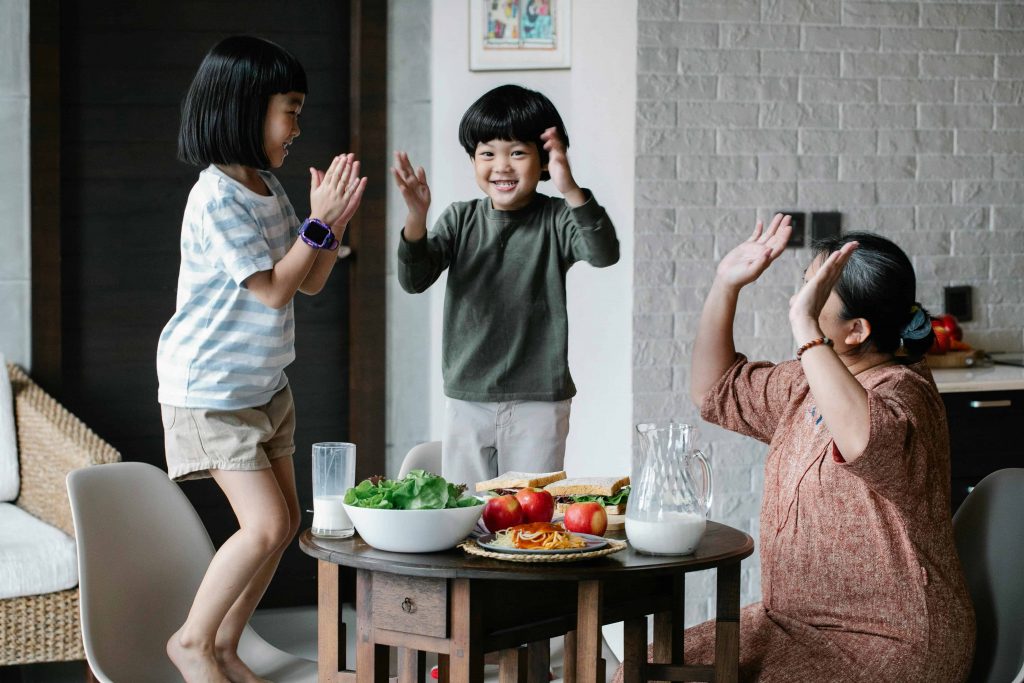
About the Photo
The photo shows:
Two young children standing on chairs at a dining table laden with food, clapping and smiling. An elderly woman sits across from them, smiling and raising her hands to join in their joy.
Sample SBC Responses Using PEER with the Photo
Question 1:
“How do you think the people in the photograph might be feeling? Why?”
P: I think the children are feeling thrilled and they are full of energy, and the elderly woman looks amused.
E: The kids are standing on their chairs, clapping and laughing, which shows they’re really excited. The elderly woman is smiling and raising her hands, so she’s clearly enjoying the children’s fun. It looks like they’re sharing a happy moment together — maybe they are clapping to some music or just being silly.
E: This reminds me of my grandmother’s birthday a few years ago. My cousins and I made up a silly birthday dance and we moved in unscripted harmony. I think we struck such a comical spectacle that her laughter threatened to send the cake on her plate tumbling!
R: I think special moments like these remind us how joyful family time can be, especially when everyone, young or old, is involved.
Question 2:
“Do you enjoy being with your older relative? Why or why not?”
P: Yes, I really enjoy spending time with my grandmother.
E: She’s always kind and calm, and even though she doesn’t talk a lot, she always listens when I speak. I feel like she really pays attention, even to the mundane things I say.
E: Once, I was feeling upset after doing badly in a test, and I didn’t want to talk to anyone. When my grandmother picked me up after school that day, I kept very silent throughout the 15-minute walk home. She didn’t ask questions. She just quietly made my favourite noodles and sat beside me. After a while, we started chatting, and I felt a lot better.
R: I think being with someone who knows how to comfort you without needing many words is really special. That’s why time with her always feels safe and reassuring.
Question 3:
“Do you think it is important to have a good relationship with your elderly relatives?”
P: Yes, I think having a strong bond with our elderly relatives is very important.
E: Having lived through very different times, they carry unique stories and advice that you won’t find in any book. Through these, they help us understand and appreciate our family’s history.
E: My grandfather once shared a “family secret” — that my dad was terrified of chickens when he was young! He said my dad used to run away from them at kampong farms, and he once hid in a cupboard from a rooster which pursued him all the way to his house. I never saw my dad the same way again!
R: I feel like these stories and shared moments help us see our family in a new light. Keeping close relationships with our grandparents adds laughter, wisdom, and a sense of belonging.
Why This PEER Answer Works:
- Covers both people in the photo using descriptive language
- Shows inference based on body language and expressions
- Gives a short, natural personal story
- Ends with a reflective message about the broader theme (family bonding and respect)
TIPS TO PREDICT SBC QUESTIONS FROM ANY PHOTO
When you see the photo, ask yourself:
- What emotions are shown?
- What life values are involved?
- What personal memory does it remind you of?
In this case (elderly relative & children):
- Themes: Relationships, respect, family bonding
- Likely questions: Feelings, personal experiences, importance of family
What If You Forget PEER? Use “Why? / How? / So what?”
If you forget the full PEER structure during the exam, you can still give a strong, complete answer by following these four steps:
Step 1: Start with your basic answer.
“I like spending time with my grandmother.”
Step 2: Ask yourself “Why?”
-This helps you explain your reason.
-Think about what the person does, how it makes you feel, or what you enjoy about it.
-“Because she listens to me and makes me feel better.”
Step 3: Ask yourself “How?”
-This adds details or examples to paint a clearer picture.
-This is where you describe an action, situation, or behaviour that shows your point.
-“She usually makes my favourite noodles and sits beside me until I’m ready to talk.”
Step 4: Ask yourself “So what?”
-This helps you reflect and link it to a bigger idea.
-Think about why this matters to you, your family, or to people in general.
-“It shows that older relatives can support us in quiet but comforting ways.”
Full Answer (Why + How + So what combined):
“I like spending time with my grandmother because she listens to me and makes me feel better. She usually makes my favourite noodles and sits beside me until I’m ready to talk. It shows me that older relatives can support us in quiet but comforting ways.”
Extra practice:
- Start with your answer.
- Ask Why? → Reason.
- Ask How? → Specific action or example.
- Ask So what? → Reflection or value.
Tips to Manage Your Nerves
-Take a deep breath to calm yourself down
-Keep your hands under the table so you can fidget without anyone noticing.
-Plant your feet firmly on the ground and you might want to tap your feet lightly to the rhythm of your reading or speech.
-If you forget a word or idea, pause for a second, take a breath, and then continue. Pausing makes you sound thoughtful, not nervous.
-If you stumble over a word, just keep going. The examiners care more about your overall fluency and meaning than one small slip.
Final Checklist for Oral Exam Success
1) Read the preamble and identify PAC
2) Speak clearly and confidently
3) Use PEER to answer SBC questions
4) When describing the people in the photo, infer their feelings and/or thoughts (Question 1)
5) Engage your examiner with eye contact when sharing personal experiences
6) Add personal stories that feel natural
7) Reflect on the topic — don’t just describe
#Stay calm and enjoy the chat with the examiner!
◡̈Smile!◡̈
Final Thoughts
The Oral Exam isn’t just about speaking English — it’s about showing that you can communicate, connect and have an opinion.
Be real. Be ready to share your opinions. Let your voice be heard.
All the best and enjoy the process!